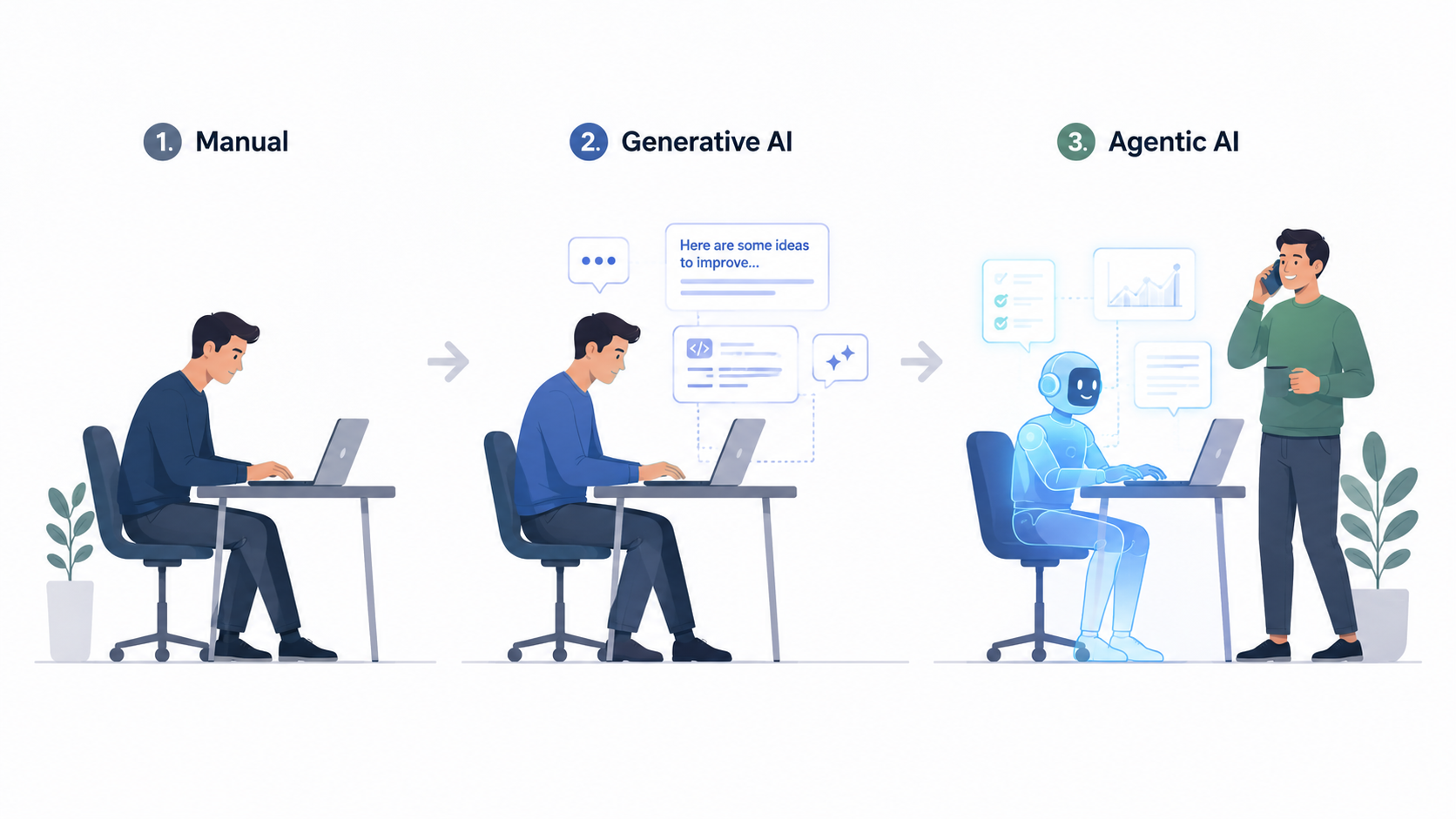
The Agent Economy is the part of the economy in which AI agents act autonomously on behalf of people, businesses, and institutions.
An AI agent is software that can pursue a goal, make decisions, use digital tools, and complete tasks with limited human supervision. The important word is agent. Simply, an AI agent acts for someone else: a travel agent acts for a traveller, an estate agent acts for a seller or buyer, and a procurement agent acts for a company. An AI agent is the software version of that role.
In the Agent Economy, a person or organization does not merely ask AI for information. They delegate work to it.
A person may say:
“Build me a simple calorie-tracking app.”
An AI coding assistant such as Replit, Cursor, Lovable, Claude Code, or OpenAI Codex can interpret the instruction, generate code, edit files, run commands, fix errors, and produce working software. The human has moved from writing every line of code to supervising an AI system that performs much of the implementation.
A shopper may say:
“Find me the best lightweight laptop under $900 for travel, with strong battery life and reliable reviews.”
An AI shopping assistant such as Amazon Rufus, Phia, Daydream, or Wizard can search, compare, summarize reviews, assess price, and recommend options. In more advanced cases, an agent can also initiate checkout with permission.
A company may say:
“Compare three compliant payroll vendors, check the contract risks, summarize pricing, and draft an internal recommendation.”
An enterprise agent can search documents, access approved company data, call external tools, produce a comparison, prepare a memo, and hand the decision back to a human manager.
This is the central shift:
Generative AI produces outputs. Agentic AI performs tasks. The Agent Economy begins when those tasks become economically meaningful.
The Agent Economy is not limited to coding or shopping. It includes customer service, procurement, travel, payments, logistics, software development, legal work, healthcare administration, education, finance, research, marketing, cybersecurity, and government services. Its basic pattern is the same across domains:
- A human or organization defines a goal.
- An AI agent interprets that goal.
- The agent plans steps.
- The agent uses tools, data, interfaces, or other agents.
- The agent returns a result, recommendation, action, transaction, or completed workflow.
- The human may approve, revise, stop, or delegate further.
The Agent Economy is therefore the economy of delegated digital action.
Why “agent”?
The word “agent” matters because it describes representation and action.
A chatbot answers.
A copilot assists.
An agent acts.
This distinction is the easiest way to understand the new category.
When someone asks ChatGPT to explain mortgages, the AI is acting as an information tool. When a mortgage-shopping agent compares lenders, checks eligibility, fills forms, flags hidden fees, and prepares an application for approval, it is acting as an economic agent.
When a designer asks an image model to generate a logo, the AI is generating an asset. When a brand agent creates the logo, tests it against guidelines, updates the website, produces social variations, schedules posts, and checks performance data, it is participating in a workflow.
When a programmer asks an AI model for a code snippet, the AI is assisting. When an AI coding agent edits the codebase, runs tests, fixes bugs, updates dependencies, and opens a pull request, it is acting.
This is why the Agent Economy is larger than “AI tools.” Tools wait for use. Agents are instructed to pursue outcomes.
The role of English and natural language
The first mass interface of the Agent Economy is plain English.
For most of computing history, humans had to learn the machine’s language. They learned programming languages, command lines, database queries, spreadsheet formulas, search operators, dropdown menus, settings panels, and software workflows.
AI agents reverse part of that relationship. The human can describe intent in ordinary language:
“Make me a landing page for a dental clinic in Harare.”
“Find flights from Johannesburg to London under $1,200 with one stop.”
“Cancel subscriptions I have not used in 90 days.”
“Summarize these support tickets and identify the root cause.”
“Build a dashboard showing revenue by product and region.”
“Find five suppliers that meet our sustainability policy.”
Today that language is often English because most leading AI products and internet datasets are strongest in English. Over time, the same interface will expand across local languages. The deeper shift is not English itself. The deeper shift is that natural language becomes an execution interface.
That is why Vibe Coding became culturally important.
Vibe Coding as the first popular example
Vibe Coding is one of the clearest early examples of the Agent Economy because it makes delegation visible.
The term was coined by AI researcher Andrej Karpathy in February 2025. Karpathy used it to describe a style of software creation in which the developer “fully gives in to the vibes,” describes what they want, and lets AI generate much of the code.
The word “vibe” can sound unserious. That is part of why it spread. But the underlying economic shift is serious: software development begins moving from direct implementation to intent supervision.
Traditional software development required the human to translate intent into code:
Idea → system design → programming language → files → tests → debugging → deployment.
Vibe Coding compresses that path:
Idea → English instruction → AI coding assistant → working prototype → human review.
This does not mean programming expertise disappears. Good developers still matter for architecture, security, reliability, performance, debugging, product judgment, and code review. But the interface changes. The human increasingly becomes the director, reviewer, and orchestrator of software work rather than the person manually writing every line.
Examples include:
- Cursor, which describes its agents as turning ideas into code.
- Replit Agent, which says users can tell the agent their app or website idea and have it built through chat.
- Lovable, which describes building full-stack applications from plain English descriptions.
- Claude Code, which can read a codebase, edit files, run commands, and help ship software using natural language.
- OpenAI Codex, which represents OpenAI’s push into agentic software engineering.
Vibe Coding is not the whole Agent Economy. It is the first mass-market cultural proof that people understand the pattern: describe the outcome, let the agent do the work, supervise the result.
The same pattern is now spreading from coding into commerce, operations, finance, research, marketing, law, healthcare, education, and government.
From Generative AI to Agentic AI
The Agent Economy is best understood as the next stage after generative AI.
Generative AI systems create text, images, audio, video, code, and analysis in response to prompts. They are powerful because they reduce the cost of producing knowledge work outputs. A marketer can generate ad copy. A student can summarize a paper. A designer can create mockups. A developer can ask for code.
Agentic AI goes further. It uses models as part of a system that can plan and act.
A generative AI system can write a hotel comparison.
An agentic AI system can search hotels, compare prices, check reviews, inspect cancellation policies, match the options to your calendar and budget, and reserve a room with permission.
A generative AI system can draft a customer-support reply.
An agentic AI system can read the ticket, inspect the customer record, check the refund policy, issue the refund if allowed, update the CRM, and escalate unusual cases.
A generative AI system can write a memo about suppliers.
An agentic AI system can search approved suppliers, request quotes, compare contract terms, check compliance requirements, and prepare a recommendation.
The difference is not merely intelligence. It is tool use and delegated authority.
An agentic system usually includes:
- a language model or reasoning model;
- instructions or goals;
- memory or context;
- access to tools;
- access to data;
- rules and permissions;
- planning or workflow logic;
- evaluation and error handling;
- human approval for sensitive actions.
The human is not always removed completely. In many cases, the human moves from operator to supervisor. They define the goal, set constraints, approve risky actions, and judge the outcome. But the agent performs more of the intermediate work.
This is why agentic AI matters economically: it automates not only content creation, but parts of decision-making, coordination, and execution.
Definition of the Agent Economy
A concise definition:
The Agent Economy is an economic system in which AI agents act on behalf of people, businesses, and institutions to perform work, make recommendations, coordinate tasks, and complete transactions.
A more complete definition:
The Agent Economy is the emerging layer of economic activity created when AI agents use natural language, software tools, data, protocols, and payment systems to search, compare, decide, produce, negotiate, buy, sell, manage, and verify outcomes on behalf of human or organizational principals.
This definition contains five important ideas.
First, the actors are AI agents. These are not only chatbots. They are systems that can act.
Second, the agent acts on behalf of someone. That someone may be a consumer, employee, founder, procurement team, government agency, doctor, student, or enterprise department.
Third, the agent uses tools. It may browse the web, call APIs, query databases, write code, update software, send messages, or initiate payments.
Fourth, the agent performs economically relevant work. It may create software, buy goods, manage subscriptions, process insurance claims, answer customers, prepare legal documents, optimize logistics, or run marketing workflows.
Fifth, the agent changes market structure. When agents become buyers, assistants, negotiators, filters, builders, and auditors, companies must design for human users and machine intermediaries.
Related concepts
AI Agent
An AI agent is a software system that can pursue a goal, reason about steps, use tools, and take action in a digital or physical environment.
The concept has roots in artificial intelligence research. Stuart Russell and Peter Norvig’s Artificial Intelligence: A Modern Approach helped popularize the view of AI as the study of agents that perceive environments and act within them. Modern AI agents extend that tradition by using large language models, tool access, memory, planning, and orchestration.
Agentic AI
Agentic AI refers to AI systems that can act with partial autonomy to accomplish goals. MIT Sloan describes agentic AI as semi- or fully autonomous systems able to perceive, reason, and act. IBM defines agentic AI as systems that can accomplish goals with limited supervision.
Autonomous agent
An autonomous agent is an agent that can act independently within defined boundaries. Full autonomy is rare in high-stakes domains because humans usually keep approval rights for payments, legal decisions, medical decisions, hiring, firing, and safety-critical actions.
Copilot
A copilot assists the human while the human remains the main operator. Microsoft Copilot, GitHub Copilot, and other copilots help users draft, summarize, code, analyze, or navigate workflows.
Agent
An agent can take more initiative than a copilot. It can plan steps, use tools, and complete tasks. The boundary between copilots and agents is not always clear, and many products use both terms.
Multi-agent system
A multi-agent system uses multiple agents that specialize in different tasks. For example, one agent may research vendors, another may check contracts, another may calculate pricing, and another may prepare a recommendation.
Agentic Commerce
Agentic Commerce is the part of the Agent Economy concerned with product discovery, comparison, shopping, checkout, payments, returns, subscriptions, procurement, and post-purchase management when AI agents act for buyers or sellers.
AI shopping assistant
An AI shopping assistant is a consumer-facing agent that helps people find, compare, evaluate, and sometimes buy products. Examples include Amazon Rufus, Phia, Daydream, Wizard, and AI shopping features inside ChatGPT, Google, Shopify, and retailer apps.
AI coding assistant
An AI coding assistant is an AI system that helps create, modify, debug, test, and ship software. Examples include Cursor, Replit Agent, Lovable, Claude Code, GitHub Copilot, OpenAI Codex, Devin, Windsurf, and similar tools.
Non-Human Customer
The Non-Human Customer is a useful term for the AI agent, recommender system, marketplace filter, procurement system, or autonomous software layer that influences what humans see, compare, trust, and buy. It is not the final consumer. It is the intermediary that shapes the consumer’s choices.
Ghost Internet
The Ghost Internet is a term for the machine-facing layer of the internet where agents read structured data, use APIs, inspect policies, query product feeds, compare reviews, access knowledge graphs, and coordinate transactions. It is “ghost” not because it is unreal, but because much of the economic action becomes invisible to human-facing analytics.
How the Agent Economy works
The Agent Economy depends on a basic loop:
Goal → context → planning → tool use → action → evaluation → human approval or continuation.
A simple example is travel booking.
A user says:
“Book a three-night business trip to Berlin next month. Keep flights under $600, avoid early departures, choose a hotel near the conference venue, and use my loyalty programs.”
The agent must:
- understand the goal;
- check the user’s calendar;
- search flight options;
- compare departure times, stopovers, baggage rules, and prices;
- search hotels near the venue;
- compare reviews, cancellation policies, and loyalty benefits;
- produce a recommendation;
- ask for approval before payment;
- complete the booking;
- add the trip to the calendar;
- monitor changes or price drops.
A business procurement example works similarly.
A procurement manager says:
“Find three vendors for SOC 2 compliance monitoring under $20,000 per year. Exclude vendors with unclear data residency. Prepare a comparison for the finance team.”
The agent must search, filter, compare, verify, and prepare a decision document.
The economic value is not that the AI writes words. The value is that it compresses a workflow that previously required hours or days of human work.
Infrastructure of the Agent Economy
The Agent Economy requires infrastructure. A powerful AI model is not enough. Agents need safe ways to connect to tools, data, websites, payment systems, and each other.
Models
Models provide reasoning, language understanding, code generation, summarization, classification, and planning. Major model providers include OpenAI, Anthropic, Google DeepMind, Meta, Mistral, Cohere, Amazon, xAI, Alibaba/Qwen, DeepSeek, and others.
Tools and APIs
Agents need tools to act. An API is a structured way for software systems to talk to each other. If an agent needs to check inventory, update a CRM, read a calendar, create a ticket, or initiate checkout, it often needs API access.
Browsers and computer use
Some agents act by using websites the way humans do. OpenAI Operator was introduced as an agent that could perform browser tasks such as filling forms, ordering groceries, and creating memes. OpenAI’s Computer-Using Agent was trained to interact with graphical user interfaces, including buttons, menus, and text fields.
This matters because many websites do not yet have agent-ready APIs. Browser-using agents provide a bridge from the human web to the agentic web.
MCP: Model Context Protocol
MCP, the Model Context Protocol, was introduced by Anthropic as an open standard for connecting AI tools to data sources and external systems.
A simple analogy: HTTP helped browsers talk to websites. MCP helps AI applications talk to tools and data sources.
The analogy is not exact. MCP does not replace HTTP. But it plays a similar standardizing role for AI agents: instead of every AI app needing a custom integration for every tool, MCP provides a common way for agents to connect to approved resources.
For example, an enterprise agent might use MCP to access a company’s document system, CRM, database, or internal tools.
A2A: Agent-to-Agent Protocol
Google’s Agent2Agent protocol was announced to help AI agents communicate, exchange information, and coordinate actions across platforms.
A simple analogy: A2A is like a common handshake and message format for agents. If one company’s procurement agent needs to communicate with another company’s sales agent, both sides need a trusted way to identify themselves, describe capabilities, exchange information, and coordinate next steps.
Without interoperability, the Agent Economy becomes a set of isolated assistants. With interoperability, agents can form networks.
Agent payments
Agents become economically significant when they can participate in transactions. That requires payments, identity, consent, limits, and accountability.
Several payment systems are being developed for agentic commerce:
- Visa Intelligent Commerce aims to enable AI agents to shop and buy with trust and safeguards.
- Mastercard Agent Pay supports agentic commerce using tokenized payment credentials.
- Google’s Agent Payments Protocol, or AP2, is an open protocol for agent-led payments.
- OpenAI and Stripe’s Agentic Commerce Protocol provides a way for AI agents and businesses to complete purchases for users.
A simple analogy: payment protocols are the “credit-card rails” for AI agents. They help answer: Is this a legitimate agent? Is it acting for a real user? What is it allowed to buy? What is the budget? Does the user need to approve? Who is responsible if something goes wrong?
Identity and authorization
If an agent can buy, cancel, sign, or transfer money, the system must know who authorized it. Identity systems will need to distinguish between humans, bots, legitimate agents, malicious agents, and merchant systems.
A future merchant may need to know:
- Is this a real agent?
- Which user or company does it represent?
- What is it authorized to do?
- What is its spending limit?
- Has the user approved this transaction?
- Can the action be audited later?
Trust and verification
Agents need reliable information. That creates demand for proof infrastructure: structured data, verified reviews, product feeds, certification records, audit logs, reputation systems, return policies, security documentation, and compliance evidence.
In the human web, a beautiful landing page could persuade. In the agentic web, agents may inspect whether claims are supported.
Main actors in the Agent Economy
Human principals
These are the people who delegate tasks to agents: consumers, employees, students, freelancers, managers, patients, investors, travellers, creators, and citizens.
Business principals
These are organizations that deploy agents: startups, enterprises, retailers, banks, hospitals, law firms, universities, governments, consultancies, media companies, and nonprofits.
Personal agents
Personal agents act for individuals. They may manage email, shopping, travel, subscriptions, calendars, learning, health routines, household spending, and personal finance.
Enterprise agents
Enterprise agents act inside businesses. They may handle customer support, sales outreach, procurement, compliance, financial analysis, HR workflows, coding, cybersecurity monitoring, and internal knowledge management.
Buyer agents
Buyer agents represent demand. They compare options, check prices, verify claims, negotiate terms, and recommend purchases.
Seller agents
Seller agents represent supply. They answer buyer-agent questions, expose product data, prepare quotes, handle support, process returns, and negotiate.
Platform agents
Platform agents live inside large ecosystems such as Amazon, Google, Microsoft, Salesforce, Shopify, Apple, Meta, Walmart, Visa, Mastercard, and OpenAI.
Infrastructure providers
Infrastructure providers supply models, chips, cloud computing, data centers, orchestration software, vector databases, observability, identity, security, payments, and developer frameworks.
Regulators
Regulators will shape how agents handle consent, liability, privacy, competition, employment, consumer protection, fraud, discrimination, and safety.
Major domains of the Agent Economy
Software development
Software development is one of the first major agentic domains because code is digital, testable, and connected to tools. AI coding assistants can generate code, edit files, run tests, explain errors, and create prototypes.
Examples include Cursor, Replit Agent, Lovable, Claude Code, GitHub Copilot, OpenAI Codex, Devin, Windsurf, and related tools.
Economic impact: lower cost of prototyping, faster software development, more startups, more internal software creation, and pressure on some traditional software development roles.
Ecommerce and shopping
AI shopping assistants help users discover, compare, and buy products. They can read reviews, compare prices, assess alternatives, apply coupons, and eventually purchase with permission.
Examples include Amazon Rufus, Phia, Daydream, Wizard, ChatGPT shopping, Google shopping agents, Shopify catalog integrations, and retailer-specific assistants.
Economic impact: product discovery moves from keyword search to conversational intent; brands must become understandable and verifiable to agents; marketplaces may gain or lose power depending on where agents search.
B2B procurement
Procurement agents can search suppliers, compare pricing, check compliance, read contracts, prepare RFPs, and monitor vendor performance.
Economic impact: more efficient purchasing, greater buyer power, less tolerance for unclear pricing, and pressure on vendors that rely on opaque sales processes.
Customer service
Customer service agents can answer questions, check account data, process refunds, route tickets, summarize interactions, and escalate complex cases.
Economic impact: lower support costs, faster response times, fewer entry-level support roles, and new risks if agents make mistakes or frustrate customers.
Finance
Finance agents can analyze spending, compare products, detect unused subscriptions, summarize investment research, assist with budgeting, support fraud monitoring, and help with accounting.
Economic impact: reduced friction in personal finance and business finance; increased need for authorization, auditability, and regulatory compliance.
Travel
Travel agents can search flights, hotels, visas, insurance, restaurants, events, and transport options. Unlike traditional travel websites, AI agents can match options to personal preferences and constraints.
Economic impact: travel discovery becomes more personalized; hotels and airlines must make policies, availability, and pricing agent-readable.
Healthcare administration
Healthcare agents can schedule appointments, summarize patient records, assist clinicians, manage insurance paperwork, monitor adherence, and support triage.
Economic impact: possible productivity gains in overloaded systems, but high regulatory and safety requirements.
Legal and compliance
Legal agents can summarize contracts, flag risks, compare clauses, monitor regulation, generate first drafts, and support due diligence.
Economic impact: faster document work and contract review, but persistent need for human legal judgment and accountability.
Education
Education agents can tutor students, generate practice exercises, adapt explanations, provide feedback, and help teachers prepare materials.
Economic impact: personalized learning at scale, but new concerns about cheating, dependency, assessment, and the role of teachers.
Marketing and advertising
Marketing agents can generate campaigns, analyze audiences, summarize customer feedback, test creative, manage ads, and optimize content. At the same time, consumer agents may filter marketing, verify claims, and recommend alternatives.
Economic impact: marketing becomes two-sided. Brands use AI to persuade and operate; customers use AI to compare, ignore, verify, and decide.
Cybersecurity
Security agents can monitor alerts, triage incidents, summarize logs, detect anomalies, and respond to known threats.
Economic impact: faster response to threats, but also new attack surfaces as malicious actors use agents for phishing, reconnaissance, and exploitation.
Government and public services
Government agents can help citizens navigate benefits, taxes, licensing, immigration forms, healthcare systems, and public information.
Economic impact: better service access, lower administrative burden, and major questions about privacy, fairness, transparency, and accountability.
Size and growth
The Agent Economy is difficult to measure because it is not one industry. It cuts across AI infrastructure, software, ecommerce, payments, labor markets, advertising, cloud computing, enterprise software, consulting, and public services.
Several proxy measures show its scale.
McKinsey estimates that agentic commerce could orchestrate $3 trillion to $5 trillion in global consumer commerce by 2030. That figure covers commerce, not the entire Agent Economy.
Gartner predicts that by 2028, 33% of enterprise software applications will include agentic AI and at least 15% of day-to-day work decisions will be made autonomously through agentic AI.
McKinsey’s 2025 State of AI survey found that 23% of respondents reported scaling an agentic AI system somewhere in their enterprise, while another 39% had begun experimenting with AI agents.
BCG estimates that AI agents accounted for about 17% of total AI value in 2025 and could reach 29% by 2028.
IDC projects global AI infrastructure spending will surpass $1 trillion by 2029. This matters because agents require inference, memory, tool calls, orchestration, and secure execution.
WEF’s Future of Jobs Report 2025 estimates that job disruption will affect 22% of jobs by 2030, with 170 million roles created and 92 million displaced.
The Agent Economy should therefore be understood as a cross-industry economic layer rather than a single market category.
Regional development
United States
The United States currently leads in frontier AI labs, cloud platforms, AI startups, venture funding, chips, enterprise software, and agentic commerce experiments. OpenAI, Anthropic, Google, Microsoft, Amazon, Meta, NVIDIA, Salesforce, Stripe, Visa, Mastercard, Cursor, Replit, and many AI-native startups are central to the U.S. agentic ecosystem.
China
China is likely to be a major Agent Economy market because of its ecommerce platforms, super-app ecosystem, AI model development, robotics manufacturing, industrial automation, payments infrastructure, and state-led technology strategy. Export controls on advanced chips may shape the pace and structure of Chinese agent deployment.
Europe
Europe’s Agent Economy is likely to develop around enterprise software, industrial AI, trusted AI, privacy, regulation, compliance, and public-sector systems. The EU’s regulatory approach may slow some deployments but could also create demand for trusted and auditable agent infrastructure.
Japan
Japan’s role may be strongest in robotics, eldercare, manufacturing, logistics, consumer electronics, and service automation. Demographics make labor-saving agents especially relevant.
India
India is likely to become important in software services, business-process automation, fintech, government services, education, and developer tooling. Its large English-speaking technical workforce and digital public infrastructure make it a significant future agent economy market.
Middle East and Africa
The Gulf states are investing in sovereign AI infrastructure, data centers, and national AI strategies. Africa’s Agent Economy may develop through mobile money, commerce, education, public services, agriculture, translation, and small-business automation, though infrastructure and compute access remain constraints.
Benefits
Productivity
Agents can reduce the time required for repetitive cognitive work. They can draft, search, summarize, compare, monitor, coordinate, and execute workflows at speed. For businesses, this may lower operating costs and increase output per worker.
Entrepreneurship
Agents can lower the cost of starting a company. A founder can use AI to build prototypes, create marketing assets, research customers, write code, manage support, analyze data, and prepare investor materials.
Consumer protection
Buyer agents can help consumers avoid scams, compare prices, detect hidden fees, read refund policies, cancel unused subscriptions, and identify products that better fit their goals.
Accessibility
Agents can help people with disabilities, older adults, non-experts, and people with low digital literacy navigate complex systems. They can fill forms, summarize documents, translate interfaces, and explain choices.
Better public services
Government agents could help citizens access benefits, tax information, licenses, healthcare services, and legal information without navigating confusing bureaucracy.
More efficient commerce
Agentic commerce may reduce search costs, improve product matching, reduce bad purchases, and make pricing more transparent.
Faster software creation
AI coding agents can turn ideas into prototypes quickly. This may expand who can build software and increase experimentation.
Better knowledge work
Agents can help professionals focus on judgment, strategy, relationships, creativity, and high-context decisions while delegating routine execution.
Criticism and risks
Job displacement
The largest criticism is labor displacement. Agentic AI can perform tasks associated with junior developers, support agents, analysts, paralegals, marketers, researchers, assistants, and administrative workers. The risk is not only that some jobs disappear, but that entry-level career ladders weaken.
The World Economic Forum expects large job churn by 2030. Goldman Sachs previously estimated that generative AI could expose the equivalent of 300 million full-time jobs to automation while increasing global GDP.
Cognitive displacement
Cognitive displacement refers to the substitution of human knowledge work by AI systems that can write, code, research, analyze, summarize, support, design, sell, and decide. Unlike earlier automation that affected mainly physical or routine office tasks, agentic AI can affect non-routine cognitive work.
Accountability
If an agent makes a mistake, responsibility can be unclear. The user, developer, model provider, software vendor, merchant, payment network, and employer may all be involved.
Example: if a travel agent books the wrong flight, who pays? If a healthcare agent misses a warning sign, who is liable? If a procurement agent chooses a non-compliant vendor, who is responsible?
Security
Agents are vulnerable to prompt injection, data poisoning, malicious websites, compromised tools, fake reviews, and adversarial instructions. A browser-using agent can be tricked if it reads hostile content designed to manipulate its behavior.
Privacy
Personal agents become useful when they know sensitive information: calendar, emails, finances, location, health, family relationships, preferences, purchases, and work data. This creates major privacy risks.
Market concentration
If a few large platforms control the agents people use, those agents may become gatekeepers for commerce, search, software, finance, media, and public information. Businesses may become dependent on being recommended by dominant agents.
Manipulation of agents
Just as SEO created attempts to game search engines, the Agent Economy will create attempts to game AI agents. Companies may try to structure content, reviews, data, and offers in ways that manipulate agent recommendations.
Bias
Agents may reproduce bias in hiring, lending, insurance, housing, healthcare, education, policing, and product recommendations. Because agents can act at scale, biased outputs can have large consequences.
Environmental costs
The Agent Economy depends on data centers, chips, cooling, electricity, and networks. IEA projects global data-center electricity consumption could roughly double to about 945 TWh by 2030. Agentic AI may increase inference demand because agents often require repeated reasoning steps, tool calls, searches, and evaluations.
Human dependency and deskilling
If agents handle search, memory, planning, comparison, writing, coding, and decision support, people may lose practice in those skills. The long-term risk is not only automation, but dependency.
Regulatory gaps
Existing law was built around humans, firms, platforms, contracts, employees, and consumers. AI agents blur these categories. Regulators will need to clarify consent, liability, safety, privacy, identity, competition, fraud, and disclosure.
Agent-ready businesses
The Agent Economy creates a new requirement for businesses: agent readiness.
An agent-ready business can be found, understood, verified, compared, recommended, and used by AI agents.
This includes:
- clear product information;
- structured data;
- transparent pricing;
- accurate inventory;
- readable policies;
- trustworthy reviews;
- comparison pages;
- clear refund and cancellation rules;
- security and privacy documentation;
- API access where appropriate;
- agent-readable FAQs;
- verified business identity;
- support workflows agents can use;
- payment systems that can handle agent-initiated transactions.
A website designed only for humans may not be enough. Agents need reliable information they can parse. A beautiful homepage may persuade a person, but an agent may look for structured product data, verified reviews, policy clarity, and third-party evidence.
This changes marketing and ecommerce. The question is no longer only:
“Can customers find us?”
It becomes:
“Can AI agents understand, trust, compare, and recommend us?”
Economic effects
The Agent Economy may affect markets in several ways.
Lower transaction costs
Agents reduce the cost of searching, comparing, negotiating, coordinating, and monitoring. This can make markets more efficient.
Higher buyer power
If buyer agents can compare many options instantly, sellers may lose pricing power. Hidden fees, confusing terms, and poor service become easier to detect.
More pressure on weak products
Agents can compare claims against reviews, complaints, prices, policies, and alternatives. This may punish products that rely on marketing rather than performance.
New forms of advertising
Advertising may shift from clicks and impressions to conversational recommendations, sponsored answers, agent-mediated shopping, and prompt-driven commerce.
Software market disruption
If AI agents can build internal tools cheaply, some companies may buy fewer SaaS products. However, mission-critical, regulated, collaborative, and deeply integrated software may remain strong.
Continuous re-evaluation
Agents can monitor subscriptions, usage, price changes, and alternatives. Loyalty becomes less passive. An agent may ask: “You have not used this service in 60 days. Cancel?” or “A competitor now offers a cheaper plan. Switch?”
New infrastructure markets
The Agent Economy creates demand for model providers, orchestration tools, agent observability, identity, payment authorization, trust registries, compliance systems, and agent security.
Major players by layer
| Layer | Examples | Role |
|---|---|---|
| Frontier AI models | OpenAI, Anthropic, Google DeepMind, Meta, Mistral, Cohere, xAI, Amazon, Alibaba/Qwen, DeepSeek | Provide the models that power agents |
| Chips and compute | NVIDIA, AMD, TSMC, AWS, Microsoft Azure, Google Cloud, Oracle, CoreWeave | Provide infrastructure for training and inference |
| Coding agents | Cursor, Replit, Lovable, Claude Code, GitHub Copilot, OpenAI Codex, Devin, Windsurf | Help create, edit, test, and ship software |
| Shopping agents | Amazon Rufus, Phia, Daydream, Wizard, ChatGPT shopping, Google shopping features | Help users discover, compare, and buy products |
| Enterprise agents | Salesforce Agentforce, Microsoft Copilot Studio, Google Agentspace, IBM watsonx Orchestrate, ServiceNow, Workday, SAP Joule | Automate enterprise workflows |
| Payments | Visa Intelligent Commerce, Mastercard Agent Pay, Stripe/OpenAI Agentic Commerce Protocol, Google AP2 | Enable agent-authorized transactions |
| Protocols | MCP, A2A, AP2, ACP | Help agents connect to tools, other agents, and payment systems |
| Trust and security | Identity providers, bot-detection firms, AI governance platforms, audit firms, cybersecurity vendors | Make agent activity safer and more accountable |
Impact
The Agent Economy is not guaranteed to replace the current internet economy quickly. Several barriers remain.
Agents are still unreliable in many complex situations. They can hallucinate, misunderstand goals, take incorrect actions, and fail at edge cases. Many businesses lack clean data and APIs. Consumers may not trust agents with money, health, or legal decisions. Regulators may slow adoption in high-risk sectors. Payment and identity systems are still developing.
At the same time, the direction is visible. AI is moving from content generation to task execution. Coding agents, shopping assistants, browser agents, enterprise agents, agent payment systems, and interoperability protocols are already being deployed.
The Agent Economy should therefore be understood neither as hype nor as inevitability. It is an emerging economic layer whose importance will depend on capability, trust, regulation, infrastructure, and adoption.
Future development
The Agent Economy is likely to develop in stages.
Stage 1: AI assistants
Humans use AI to answer questions, draft text, summarize documents, generate images, write code snippets, and brainstorm.
Stage 2: Task agents
Agents complete bounded tasks: create a prototype, book an appointment, compare products, summarize vendors, update a spreadsheet, or answer support tickets.
Stage 3: Workflow agents
Agents manage multi-step workflows across tools: procurement, customer support, software development, sales operations, compliance, accounting, and logistics.
Stage 4: Agentic markets
Buyer agents, seller agents, payment agents, compliance agents, and logistics agents interact directly. Markets become partly machine-mediated.
Stage 5: Regulated agent economies
Governments, standards bodies, payment networks, courts, insurers, and industry groups define rules for agent identity, consent, liability, safety, auditing, and competition.
Conclusion
The Agent Economy is the economy of AI acting on behalf of humans and organizations.
Its simplest definition is:
AI agents participating in economic activity for people and businesses.
Its simplest example is Vibe Coding: a person describes software in English and an AI coding assistant helps build it.
Its broader meaning is much larger. The same pattern applies to shopping, procurement, support, finance, healthcare, travel, legal work, education, marketing, government, and operations.
The old digital economy was built around websites, search boxes, feeds, apps, clicks, and human attention. The Agent Economy is built around goals, delegation, tool use, verification, permission, and autonomous execution.
The key shift is this:
Humans move from doing every digital step themselves to instructing AI agents that act on their behalf.
That does not remove humans from the economy. It changes their role. The human becomes the principal, supervisor, approver, judge, beneficiary, and sometimes victim of agentic action.
For businesses, the central question becomes: Can agents understand, trust, and use us?
For workers, the central question becomes: Which parts of my work can be delegated, and which parts still require human judgment?
For regulators, the central question becomes: How do we govern software that can act economically?
For researchers, the central question becomes: What happens when markets contain non-human actors that search, compare, recommend, negotiate, and transact?
The Agent Economy is not a future of robots walking into shops. It is a future of software acting inside the economy before, during, and after human decisions.
The agent does not replace the human desire behind the task.
It changes who does the work between desire and outcome.
1 thought on “Agent Economy”