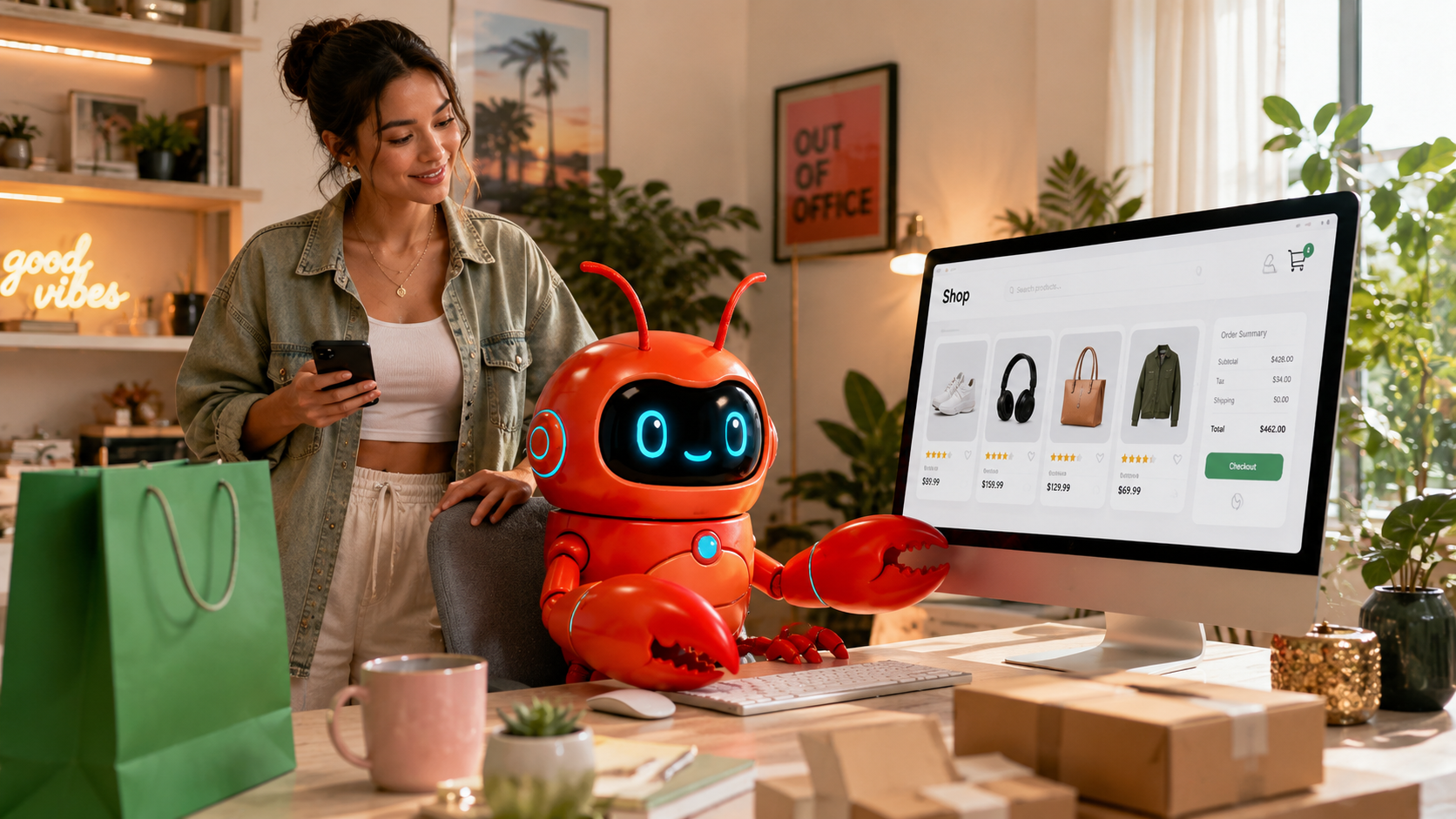
In April 1912, fifteen hundred people boarded the Titanic from Southampton, England – and they believed that the ship was unsinkable.
They were not naive. They were not being reckless. They were hopeful — they wanted to pursue the American dream. Most of them were travelling steerage — not the first-class passengers with their gilded dining rooms and their ocean-view promenades, but ordinary people from Ireland, from Italy, from Eastern Europe, from places where the future had not yet arrived. They were sailing toward America, which was not merely a destination but an idea: the proposition that a person could arrive somewhere with nothing except their desire and their willingness to act on it, and build a life from the raw material of ambition. No gatekeeper. No toll. No system designed to profit from the distance between what you wanted and what you could reach.
They were sailing toward a new world.
There is a scene in that story that has nothing to do with icebergs and tragedy.
Leonardo DiCaprio — Jack Dawson — is standing at the bow of the ship, arms wide, the Atlantic wind filling the frame, and Kate Winslet — Rose DeWitt Bukater — corseted, jewelled, promised to another man, watched over by a mother and a class system and a future already decided on her behalf — is watching him from the upper deck. She has not spoken to him yet. She does not know his name. She knows absolutely nothing about his financial prospects, his social standing, or his suitability as a life partner by any metric that her world would recognise as legitimate.
She knows one thing: she vibes with him.
That feeling — instantaneous, irrational, overwhelming, impossible to argue with — is the oldest force in human history. Long before markets existed, long before ships crossed oceans in pursuit of new worlds, human beings wanted things the moment they saw them. They wanted them because of how the wanting felt: warm, certain, clarifying, the way a good decision announces itself before the reasoning catches up. The entire history of commerce is, at its foundation, the story of what happens between that human feeling and its fulfilment. Who stands in the way. What friction the journey accumulates. How long desire is made to wait before it becomes possession.
Every era has had a new intermediary. Every intermediary has charged a toll. The shop assistant, the search engine, the algorithm, the influencer — each one inserted themselves between the moment of wanting and the moment of having, and called it service.
The people on the Titanic were sailing toward freedom. Toward a world where the only thing standing between a person and what they wanted was the wanting itself. The Titanic sank. The dream did not.
Three thousand years of commercial history have been the slow, imperfect, often painful journey toward that same shore — the shore where desire and fulfilment occupy the same instant, and nothing stands between them.
Vibe Shopping is that arrival.
You see it. You vibe with it. It is yours. Forever.
Shopping 1.0 Through to Shopping 5.0
Commerce has not merely evolved. It has followed a pattern so consistent, so geometrically inevitable, that naming it retrospectively feels almost like cheating.
Shopping 1.0 was Physical. You left your house. You travelled to where the goods were. You encountered the intermediary — the vendor, the merchant, the shop assistant — whose intimate knowledge of the product existed in direct and productive tension with their commercial motivation to sell it. The information asymmetry was built into the architecture. The butcher knew more about the meat. The car dealer knew more about the vehicle. My first car was an Alfa Romeo, purchased from a young couple in Guernsey and they spoke about it with the warmth of a person describing their firstborn child. The car revealed its actual character at speed on the UK’s Motorway, at which point the couple had become unreachable and the warranty was thinner than I had understood. The intermediary’s advantage was structural, physical, and essentially unchallengeable. If you wanted the thing, you negotiated from a position of inferior knowledge, in a room or place designed to make you feel the transaction was urgent.
Shopping 2.0 was the Internet. Suddenly the information existed — theoretically, all of it, for every product, from every retailer, at every price point, accessible to any person with an internet connection and the patience of a documentary filmmaker. The early web was a library assembled by someone who had read no cataloguing theory and maintained no organisational system. The friction transmuted rather than disappeared. It became the friction of navigation: knowing what to search, how to evaluate what you found, which retailer was legitimate, which review was fabricated, which returns policy contained the clause that would matter in thirty-one days. Booking a flight online in 1999 was a forty-five-minute ordeal of form fields, session timeouts, and the particular anxiety of entering your credit card number into a website that looked as though it had been designed during an Eskom power cut.
The global e-commerce footprint eventually reached $39.7 trillion. Mobile commerce now commands over sixty per cent of global digital sales — 1.65 billion people treating their phones as primary market interfaces. The shop had become the screen. The screen had become the pocket. The pocket had become the wallet, the catalogue, the queue, and the checkout simultaneously.
Shopping 3.0 was Social. Instagram, TikTok, Pinterest, WeChat. For the first time since the village market, the product found the person while scrolling social media rather than the person finding the product. The recommendation came from a face you recognised — or a face you were algorithmically predisposed to trust, which is commercially identical and epistemically different. The desire was activated before the browsing began. You were scrolling, and the algorithm, which had been studying your behaviour with the patient attention of a very well-funded research institute, knew what would make you stop the scroll. The friction was emotional now rather than navigational: do I trust this person? Is their relationship with this product genuine? Is the enthusiasm performance or authenticity? The intermediary had changed costume. It now wore a ring light and a personal backstory.
Shopping 4.0 was Live. China saw this before anyone. A personality. A product in motion. An audience watching in real time. A purchase completed in the same gesture as pressing a like button — impulsive, social, electric with the energy of a crowd all wanting the same thing simultaneously. The urgency was genuine because the audience was live and the inventory was limited and the community of wanting was visible and immediate. Live shopping spread from Taobao to TikTok Shop to Instagram Live, and everywhere it landed it discovered the same truth: desire is social, and social desire converts faster than any other kind.
But the intermediary, the middleman, was still there. In every incarnation of Shopping 4.0, someone stood between you and the purchase, narrating the gap and extracting their fee. The influencer. The personality. The face you trusted or the face you were taught to trust.
Shopping 5.0 is Agentic.
No shop to travel to. No search to conduct. No algorithm to second-guess. No influencer to believe or distrust. No seventeen tabs open and you don’t know which one has that annoying music playing. No returns policy written by lawyers for lawyers. No countdown timer calibrated to your specific anxiety threshold. No reference price that existed for eleven days in 2023 and is now presented as evidence of a massive huge sixty per cent discount.
You see it. You vibe with it. The AI agent handles everything that happens next.
That’s shopping 5.0.
Each transition in this sequence has been a compression of the distance between desire and possession. Each transition has been faster than the one before it. And if you read the arc correctly — 1.0 to 2.0 to 3.0 to 4.0 to 5.0 — you see not a series of incremental improvements but a single sustained movement toward one destination: a world in which desire and fulfilment are happen in the same instant, and nothing stands between them.
We have arrived.
The Monster You Are About to Steal From
Before I discuss the theft that I am about to commit with everyone watching, I must honour the giant I am stealing from. Besides, there is a quote about great artist steal…Anyway.
In February 2025, Andrej Karpathy — an AI researcher whose contributions to modern machine learning carry the kind of weight that only the genuinely foundational work accumulates over time — published a short note describing a new way to build software using AI. Describe what you want in plain English. Let the AI create it. Review the output. Describe what needs to change. Ship it. Done.
He called it vibe coding.
The phrase became viral and it travelled at the velocity of things that are true and funny and slightly dangerous simultaneously. Within months, Karpathy had not merely named a trend — he had reorganised an entire industry’s self-understanding. The financial consequences were not modest. Anthropic, whose Claude Code became the enterprise instrument of vibe coding, just a few days ago filed for an IPO at a valuation approaching one trillion dollars — a company that, two years earlier, was valued at a fraction of that. OpenAI, whose models power the parallel half of this revolution, occupies the same stratospheric neighbourhood. Cursor became a billion-dollar company in the time it previously took to hire a senior engineering team. Replit transformed from a niche development environment into a platform where non-technical founders were shipping real products in single afternoons.
The case that most clearly illustrates the scale of what has arrived: Anthropic’s entire growth marketing function — for a company that grew from $365 billion to one trillion dollars in valuation — was run by a single human being, Austin Lau, and an AI agent. One person. One AI agent. A growth trajectory that, under conventional operational assumptions, would have required a department of at least fifty to one-hundred marketing specialists, four marketing agency relationships, two senior vice presidents, and a quarterly budget that would fund a small infrastructure project.
This is not a curiosity. It is an announcement.
But here is the announcement that sits inside the announcement, the one that the technology industry has not yet fully faced.
The same agentic AI that built Anthropic’s growth machine is now looking at every other function in every other company. Not just marketing. Engineering. Legal. Procurement. Finance. Customer service. Marketing. The junior analyst whose career once began with the kind of work that built expertise through repetition — the work is now being done by an AI model that does not need the career path because it does not have a career. A famous comedian Ronny Chieng recently delivered a widely shared speech where he labeled current AI “stupid,” warned of cognitive debt, and told university graduates that their mission was to “destroy AI” to protect true human mastery. He was not wrong. He was simply describing the situation from the wrong angle.
Here is the other angle.
The displacement by AI is real. The opportunity that arrives with it is also real. When the economic machine reduces the labour it requires to function, it does not reduce desire. It does not reduce the need to acquire things, to clothe children, to furnish homes, to find the running shoes that fit the exact gait analysis your AI agent has been quietly conducting for the past eighteen months. The unemployed still shop. The displaced still want things. And the question of who serves them — who stands on the side of the human consumer rather than the side of the corporation extracting value from their confusion — is one of the defining commercial and ethical questions of the 2020s.
Capitalist, here is your redemption arc: the same AI that ate the jobs can now be aimed, with precision and genuine consequence, at protecting the people those jobs belonged to. As buyers. As consumers. As the humans navigating a commercial world that was never designed to work in their favour.
Vibe coding democratised software creation. Vibe shopping will democratise the act of consuming itself — making every human being, employed or not, young or old, technically fluent or entirely innocent of the internet’s architecture, an optimal, protected, maximally informed participant in the global economy.
ChatGPT is on version 5.6. Anthropic has released Mythos. The models are not slowing down. Agentic AI is now eating software — the same software that, in Marc Andreessen’s famous phrase, was eating the world. The predator has been consumed by its own evolutionary descendant.
And if you think that is the big story, you are not ready for what comes next!
On the Phenomenology of Wanting Things: Two Cities, One Truth
There is a moment — every human who has ever walked through a city with their eyes open and not glued to their phone has experienced it — when the world stops being background and becomes specific.
You are in Paris in September. Not the tourist Paris of queues and photographs, but the interior Paris of a Wednesday morning, when the city is operating on its own terms and the light has that particular quality — low, golden, slightly theatrical — that makes the Boulevard Saint-Germain feel like the establishing shot of a film you want to live inside. Emily in Paris style. You pass the window of a Louis Vuitton boutique and through the glass you see a bag — not the monogram that tourists photograph, but a structured leather piece in a cognac brown that catches the light with the quiet confidence of something designed to be owned rather than admired. You do not think about it. The want arrives before the language does. It is already present by the time the conscious mind catches up to ask: what was that?
This is not weakness. This is not superficiality. This is the oldest and most sophisticated evaluation system the human species possesses: rapid, pattern-matching, visceral, startlingly accurate. We call it taste when it operates in culture and instinct when it operates in nature, but the mechanism is identical — a judgement rendered below the threshold of deliberation, a certainty that arrives before the evidence has been consciously assembled.
Three streets away, through the glass of a Givenchy boutique, a coat hangs in the window. Black. Architectural. The kind of garment that does not merely clothe a person but makes an argument about who they are. The Seine is visible from this corner, grey-green in the September light, and the traffic on the Pont Neuf is a river of its own, and the smell of coffee from a nearby café has mingled with the cold air in a way that makes everything feel simultaneously real and cinematic. You stop. You look. You feel.
Now cross the Channel.
It is a Wednesday morning in September in London. Its London Fashion Week. The weather has arrived in the specific way London weather arrives in September — not dramatically, but insistently, with the grey committed persistence of something that has nowhere else to be. You are on Oxford Street, which is not beautiful in the way Paris is beautiful but is busy in the way that only truly democratic places are busy: every age, every background, every budget, a city-state of shopping in perpetual motion. The red buses are stuck in the particular traffic that is Oxford Street’s gift to the environmental record. There are tourists photographing things. There are office workers cutting through with the focused efficiency of people who know which Pret has the shortest queue.
You pass a window. Paul Smith. And there — in the particular palette that Paul Smith has made his signature, a kind of maximalist optimism rendered in bright emerald and warm orange and the kind of confidence that British fashion achieves when it stops apologising for having colour — is a jacket. Not expensive in the way that Mayfair is expensive. Expensive in the way that something made with care is expensive. The mannequin wears it with the ease of a person who found exactly the right thing at exactly the right moment, and something in you responds.
Two streets further, through the glass of a Burberry store on Regent Street, a trench coat hangs in the particular camel that Burberry has owned for a century. London is in the glass, reflected: the street, the traffic, the grey sky, the red buses blurred to streaks of colour. You are looking at a garment and also at the city that made it, and the feeling is not the same feeling as Paris — it is colder, drier, more empirical — but it arrives with the same velocity and the same certainty.
In both cities, in both moments, the same ancient protocol fires: I vibed with that.
In both cities, in both moments, your mother would have stopped a stranger and asked where they bought it. Your friend would have taken a picture, sent a screenshot to six people and awaited a verdict. You would have opened a browser, typed something approximate, encountered seventeen results of variable relevance, and either persevered or abandoned the quest sometime around the second tab.
That entire sequence — from desire to acquisition — is the friction that shopping has always charged for the privilege of wanting something. The desire was free. The fulfilment cost you your whole entire afternoon.
In Shopping 5.0, you raise your phone for three seconds. Your agent identifies the bag, the coat, the jacket — from a photograph, from a description, from the sound of you saying the green Paul Smith thing in the Regent Street window while you are already walking away. It finds the item, the size, the price, the best available option from your preferred delivery timeline, reads the returns policy so you do not have to, and asks a single question: Shall I buy it for you?
This is what vibe shopping does not merely for the affluent shopper on Regent Street, but for every human being on earth who has ever stopped in front of a window and felt something. Which is, to the extent we have any data on the matter, every human being on earth.
The Great Incumbent-Challenger Pattern: History Doesn’t Repeat, But It Rhymes With Remarkable Precision
Here is what the most consequential commercial transitions of the past thirty years have in common, and what nobody writes about because it is too simple to seem profound.
The challenger always looks worse at first.
Netflix, in 2000, had a catalogue that Blockbuster could not have envied. You ordered a DVD by post and waited three days for it to arrive. Blockbuster had eleven thousand stores across the world, sixty million members, and the ability to put a film in your hands in twelve minutes. The incumbent, Blockbuster, looked like the only rational choice if you wanted to watch a film at home. Meanwhile, Netflix looked like a science experiment conducted by delusional optimists.
Streaming, when it arrived, had lower picture quality than cable, a smaller content library, and a dependence on internet broadband infrastructure that, in 2007, was not the universal utility it later became. Cable had the regulatory capture, the content relationships, and the billing relationships with every household in the developed world. The incumbent looked impregnable.
Mobile, in 2005, had a small screen, a soft keyboard, a battery that lasted a working day if you kept your expectations modest, and apps that were, by any objective standard, inferior to their desktop equivalents. Desktop computing had the enterprise relationships, the developer ecosystem, and a century of furniture arranged around the assumption that important work happened while seated at a desk.
In every case, the resolution followed the same rhythm: the challenger was more accessible, or more convenient, or reached people the incumbent structurally could not. The challenger removed a friction that the incumbent had disguised as a feature. And then the network effects compounded, and the adoption curve inflected, and the incumbent spent the next decade writing internal memos about digital transformation strategies and the next decade after that as a business school case study.
Vibe coding is the most recent incumbent in this sequence — not because it is old, but because it has a participation ceiling that is structurally identical to every previous incumbent’s fatal limitation. Vibe coding is for people with technical intuition. It expands the coder population from thirty million to perhaps a billion — an extraordinary achievement, a genuine democratisation of software creation, a transformation that has correctly attracted trillion-dollar valuations and Jensen Huang’s most expansive proclamations.
BUT one billion is not eight billion.
History does not repeat itself in commerce. But it rhymes, and the rhyme scheme here is unambiguous: the technology that reaches everyone defeats the technology that reaches the most.
Vibe shopping reaches the elderly woman whose arthritic hands make keyboards painful and whose voice is clear and whose desire for a comfortable cardigan from Pringle in a specific shade of blue is entirely legitimate. It reaches the blind teenager who navigates the world by sound and whose AI agent can search, compare, and verify every product attribute without requiring the teenager to visit a single visual interface. It reaches the five-year-old who wants the toy she saw in the animated film and can describe it in fourteen words with absolute precision. It reaches the procurement manager in Singapore who needs to renew six software contracts before Thursday and has a team of two and a complexity problem that would have required a consultancy engagement in 2026.
It reaches, without exception or modification, every person on earth who has ever wanted something available online.
Vibe coding eats software. Vibe shopping eats commerce. Commerce is larger than software by roughly the same margin that the ocean is larger than a swimming pool. The rhyme resolves the same way it always does: the technology that reaches everyone writes the next chapter, and everything else becomes the previous chapter that the next generation studies to understand how the world changed.
The implications are not modest. The advertising industry built around human attention must now account for an intermediary that has no attention to purchase. The brand equity accumulated through decades of emotional investment in human imagination must now be supplemented by evidence architecture that an AI Agent can evaluate. The SEO industry built on human cognitive limitations — the fact that ninety-one per cent of people never go to the second page of search results — must reconstitute itself around an agent that has no second page, because it has the entire indexed web, evaluated against your specific parameters, returned as a recommendation rather than a ranked list.
The $90 billion SEO industry was built because humans stopped at the first page. Vibe shopping is about to build something larger in the space left behind.
The Definition: A Story About the Morning Shopping Changed
Her name was Clara, and she was going to be late.
She was always going to be late on Wednesdays. She had a meeting at nine that reliably ran until nine-forty, a coffee shop she was reliably loyal to on Marylebone High Street, and a route between the two that passed through the kind of neighbourhood where the windows have opinions. She had learned, over two years of this particular commute, that the safe strategy was to look straight ahead. The windows were not designed for browsing. They were designed for stopping, and stopping made her later still.
She still stopped. Desire is stubborn.
In the window of a shop she would not later be able to name with certainty — something small, something independent, something that had clearly survived the rent increases by being unreasonably good at its purpose — was a dress. Not extraordinary, not the kind of thing that required superlatives. Just exactly, with a precision that felt almost personal, right. The colour was a kind of dusty rose that suggested warmth without demanding attention. The cut was generous without being formless. Something about it made her feel, in the two seconds she stood on the pavement looking at it, that the person wearing it would move through the world with a particular lightness.
She took out her phone. Not to browse. Not to search. She held it up for three seconds. Her AI agent identified the garment, cross-referenced it across current inventory in her size across forty-three retailers, noted that the boutique in the window was actually selling it at fifteen per cent above the median market price for the same item from the same manufacturer, found two equivalent options at better prices with superior return policies, and presented her with a single notification: Found it. Best price: £112 at a boutique on Carnaby Street. Free delivery tomorrow. Same item. Shall I?
She said yes. She kept walking. She was only four minutes late, which for a Wednesday was essentially punctual.
She had not visited a website. She had not read a single review, though her agent had — four hundred and twelve of them, across three platforms, filtered for authenticity and weighted toward buyers with her demonstrated taste profile. She had not discovered, on the third page of the returns policy, the clause about unworn condition with original tags attached. Her agent had discovered it, assessed it as reasonable given her purchase history, and factored it into the recommendation. She had not compared prices, worried about delivery, or wondered whether the item she was ordering was the same item she had seen in the window.
Her agent had done all of it. She had provided exactly one thing: the feeling.
That is Vibe Shopping.
Not a product category. Not a feature. A fundamental reorientation of the commercial relationship between human desire and its fulfilment — one in which the human provides the wanting and artificial intelligence (AI) provides everything else.
Vibe Shopping is the act of expressing a desire in any natural human form — a word, a voice note, a photograph, a video fragment, a gesture, a mood — and having an AI agent research, compare, verify, and complete the acquisition on your behalf, without you navigating a single interface.
Vibe Shopping is what happens when the personal shopper that only the very wealthy could previously afford becomes available to every human being on earth simultaneously.
Vibe Shopping is the delegate layer that sits above the entire $77.58 trillion global retail market, converting every human desire into an optimal, protected, informed transaction, regardless of the human’s technical ability, physical capability, or available time.
The Freedom of Vibe Shopping: Unshackled at Last
Here is what nobody has said yet about the difference between vibe coding and vibe shopping, and it is perhaps the most personally liberating truth in this entire essay.
Vibe coding tethers you to a device. You need a screen. You need a keyboard. You need enough processing technical context to evaluate the output, iterate on it, understand — at some level — what the agent has built and whether it functions as intended. The vibe coder sits at a laptop. The vibe coder stares at a terminal. The vibe coder is, however liberated from formal syntax, still fundamentally a person at a desk doing something that looks, from the outside, like work.
Vibe shopping releases you from the desk entirely.
You are at a show on the Broadway, and the person on stage is wearing boots you have never seen before, and your agent, which has been quietly listening to everything you experience, notes the visual signal and asks: Did you want me to find those? You are on a train through the Swiss Alps, and the woman in the opposite seat has a jacket with a collar you keep looking at, and four words is all it takes. You are watching a film on Netflix on your sofa on a Sunday evening and the protagonist’s apartment contains a lamp that would be perfect in your study, and you pause the screen and point, and that is enough.
Your smart television. Your smart speaker. Your smart watch. Your smart phone. Your laptop. Your car’s dashboard, on a long drive, when you hear a song that reminds you that you need new headphones. Your smart refrigerator, in the specific version of the near future where it has noticed that you are running low on three things and your agent has been briefed to replenish them without requiring you to interact with any interface at all.
Intelligence is becoming cheap — vertiginously, almost incomprehensibly cheap, in the same way that computing became cheap and internet connectivity became cheap, in the same way that every enabling technology eventually reaches the point where its cost approaches zero and its ubiquity approaches total. When intelligence is effectively free, it can live everywhere: in every device, on every surface, available at every moment of desire without requiring the desire to travel to the device. The device is wherever you are.
Vibe coding requires you to be present and deliberate. Vibe shopping accompanies you through your life, waiting for the feeling. It is the difference between visiting the library and having a librarian who walks beside you through the world, noting everything you look at twice and whispering: shall I find that for you?
The Numbers That Should Change How You Think About Every Investment You Make
Global e-commerce crossed $6 trillion in 2024. It is projected to reach $77.58 trillion by 2031 — a figure that represents not a niche digital channel but one-fifth of all economic activity on earth, growing toward one-quarter. The global retail market, online and offline combined, already exceeds $30 trillion annually.
Against that backdrop, the agentic commerce market — the specific layer where AI agents mediate purchasing decisions — was valued at between $1.9 billion and $5.71 billion in 2025 and is projected to reach between $54 billion and $65 billion by 2033, growing at between thirty-five and forty per cent annually. The global agentic AI market in retail and e-commerce has already crossed $61.9 billion and is tracking toward $863.3 billion by 2035.
During the 2025 holiday shopping season, AI agents directly influenced $262 billion in global sales. On a single Black Friday, AI-mediated transactions exceeded $3 billion.
Morgan Stanley — analysts not known for theatrical excess — estimates that agentic shoppers could account for ten to twenty per cent of US e-commerce alone by 2030, representing $190 to $385 billion in a single national market. Twenty-three per cent of Americans had already used AI for purchases within a single month of being surveyed — before the infrastructure was fully assembled.
Vibe coding operates within a software development market worth approximately $650 billion annually. The market that vibe shopping operates within is not comparable to software development. It is not comparable to any single industry. The market that vibe shopping operates within is the entirety of human acquisition — everything that every person, every family, every business on earth purchases — and it is measured not in hundreds of billions but in tens of trillions.
The Intent Abstraction Ladder — offered here for analysts and investors to use freely:
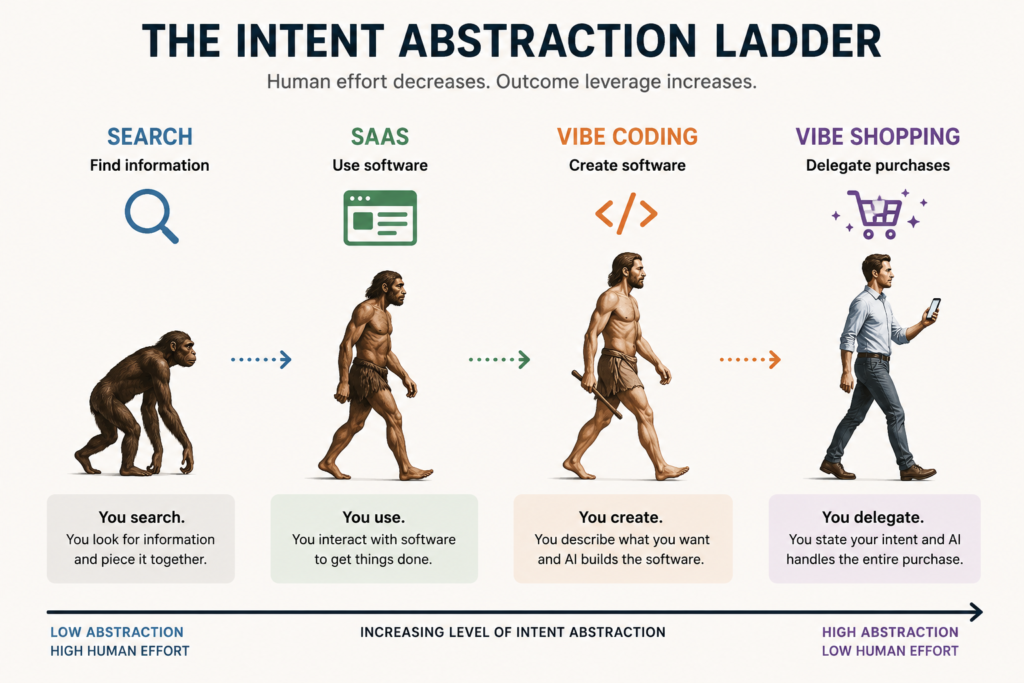
The first rung is search: find information. The second is SaaS: use software. The third is vibe coding: create software through natural language. The fourth — the one that has no participation ceiling, the one that reaches every human being alive — is vibe shopping: delegate the entirety of the purchasing decision, and receive an outcome.
Each rung abstracts away another layer of complexity. Each rung expands the addressable population. The final rung has no exclusions. The only criterion for participation is the desire to acquire something. This is not a demographic segment. It is a characteristic of the species.
The Trust Question — And Why History Has Already Answered It
The most serious objection to vibe shopping is the one that sounds obviously true: people will not trust an AI agent to spend their money.
This objection deserves respect, careful examination, and then the empirical response it cannot survive.
In 1999, the proposition being made to ordinary people was: enter your credit card number into a website operated by a company you cannot visit, cannot call with confidence, and cannot verify through any mechanism you have previously used to evaluate commercial trustworthiness. The scepticism was not irrational. It was proportionate. People had spent their entire commercial lives transacting with businesses they could physically locate. The internet offered none of this.
They said they would never buy shoes online without trying them first. They bought shoes online. They said they would never complete a mortgage application without sitting in a bank branch with a human across the desk. They completed mortgage applications on their phones. They said they would never buy a car without a test drive arranged through a physical dealership. They bought cars through online auctions, sight unseen, delivered to their driveway. The fear did not expire through argument. It dissolved through accumulated positive experience. One transaction that went right. Then a thousand. Then a million.
The trust-building infrastructure for agent-mediated commerce is not being left to chance this time.
Mastercard’s Agent Pay programme creates authenticated, secure, liability-protected transaction rails specifically for AI agents — the commercial equivalent of the SSL certificate that made online credit card entry feel safe. Anthropic’s constitutional AI frameworks make Claude’s alignment with user interests demonstrably verifiable. Google’s Gemini ecosystem displays, in readable form, what the agent did and why before any transaction is confirmed. Shopify rebuilt substantial portions of its checkout infrastructure to make agent transactions as secure as human-initiated ones. Amazon deploys explicit buyer-protection coverage on every Rufus recommendation. Wizard Commerce is building the verification layer that allows consumers to audit every agent decision before any money moves.
The trust gap is real. It is also being closed by the most technically capable and commercially motivated organisations in history. The timeline for mainstream normalisation, by analogy to mobile banking’s trust arc: 2027 to 2029 in leading markets. The evidence — twenty-three per cent adoption before full infrastructure assembly — suggests the curve may inflect earlier.
The B2B Dimension: Procurement’s Quiet Disappearance
The consumer story is the warmer one, the more photogenic one, the one involving Clara and the Marylebone dress and the agent that read four hundred reviews so she didn’t have to. But there is a parallel transformation in business purchasing that is, in aggregate, considerably larger in absolute terms, and considerably less discussed in the places where the consumer story dominates.
Global business-to-business (B2B) commerce dwarfs B2C in transaction volume. The procurement function — the mechanism by which organisations acquire software, services, logistics, supplies, and professional capabilities — is a multi-trillion-dollar market characterised by a level of inefficiency that would be scandalous if it were not so thoroughly normalised. The average enterprise software sales cycle runs between six and eighteen months. It consumes procurement committee time, legal review capacity, compliance audit bandwidth, and the attention of consultants whose primary function is navigating a complexity that should not need to exist.
Consider the alternative.
An AI agent, briefed on an organisation’s requirements, budget parameters, compliance obligations, and existing vendor relationships, can compress that cycle from eighteen months to forty-eight hours. It reads every existing contract. It surveys the competitive landscape across every qualified vendor. It benchmarks pricing, assesses contractual risk, flags compliance issues specific to the organisation’s regulatory environment, and produces a recommendation that encompasses analysis no human procurement team — however talented, however large — could replicate at comparable speed or completeness. It negotiates directly with vendor APIs. It manages renewal calendars. It terminates arrangements that no longer represent value without requiring a meeting or a chain of emails with seventeen participants and no clear owner.
The dedicated procurement department — a significant operating cost at every large organisation, staffed by professionals whose expertise lies in navigating a complexity that agentic AI can now dissolve — faces the same recalibration that customer service departments have already begun. Not immediate elimination. Something more permanent: the progressive reallocation of human judgement toward the genuinely relational and creative dimensions of vendor management, while routine evaluation, comparison, and transactional execution migrates to agents that do it faster, more comprehensively, and with access to more current information than any team could maintain.
The startup with twelve people in Lisbon now competes for the contract that previously went to the established vendor with the twenty-year relationship and the golf handicap. The agent evaluating the contract is looking at evidence, not history. This is the most quietly significant equalisation in the history of business commerce, and it has received a fraction of the attention it deserves.
The Infrastructure: What Has Been Built and What Remains
The Model Context Protocol (MCP), developed by Anthropic, provides agents with a standardised pathway to connect to external data sources — product catalogues, booking systems, financial APIs, review databases — without requiring bespoke engineering for each connection. As HTTP provided the universal language for browsers to communicate with servers, MCP provides the universal language for AI agents to interact with the commercial web. A merchant whose catalogue is MCP-compatible becomes immediately queryable by every agent on every platform.
Google’s Agent-to-Agent (A2A) protocol enables agents to consult one another — your personal agent coordinates with a specialist travel agent, a specialist financial agent, a specialist logistics agent, synthesising their outputs into a single recommendation, the way a trusted human advisory network once operated, minus the scheduling problem and the conflicting fee structures.
What remains: a universal agent payment standard, enabling agents to execute transactions within pre-approved parameters without requiring human presence at settlement. Visa, Mastercard, and Stripe are each building toward this. The first to establish it becomes the financial infrastructure of the agent economy. Not merely a payment processor. The Visa of a market that did not exist five years ago and is projected to touch trillions within ten.
The tipping point requires cheap intelligence — already arrived, still falling. It requires reliable infrastructure — being assembled now, at speed, by the most capitalised engineering organisations in history. And it requires an experience better than the alternative. The alternative, as currently constituted, is seventeen tabs, an ambiguous returns policy, a fake countdown timer, and a reference price that was inflated last Tuesday specifically to create the feeling of urgency.
The timeline: 2027 to 2029 for majority normalisation in leading markets. By 2032, the question will not be whether you use an agent for purchasing. It will be which agent, at what tier of capability, with how many specialised sub-agents operating in parallel.
The Players Building What Comes Next
OpenAI, at version 5.6 of ChatGPT, with Instant Checkout integrated into over a million Shopify stores, is becoming a shopping interface in the same way Google became a shopping interface in 2002 — not by design, but by the logic of where human attention concentrates.
Google’s Gemini agents are embedded in Android, which runs on seventy-two per cent of the world’s smartphones. If Google deploys vibe shopping through the operating system rather than a separate application, it arrives as a software update to the majority of the world’s consumers simultaneously.
Anthropic’s Mythos builds on the constitutional AI architecture that made Claude the preferred enterprise agent, extending its capabilities into long-horizon commercial reasoning that can manage not a single transaction but an entire commercial relationship over time.
Shopify’s CEO Tobi Lütke has explicitly described AI agents as a new category of customer that merchants must design for. The infrastructure is being rebuilt with agent-compatibility as a first-class requirement rather than a retrofit.
Amazon’s Rufus sits atop the world’s largest logistics network and the world’s most comprehensive product catalogue. If this achieves what the recommendation engine achieved in 2005, the compound effect writes the defining commercial story of the 2030s.
In China, OpenClaw — the platform whose adoption spread through major cities this year with the velocity of something the culture had been quietly anticipating — demonstrated what the premium tier of this market looks like: not a shopping tool but a representative, entrusted with the full complexity of a person’s commercial life, cultivated with the patience and intimacy that a previous generation reserved for a trusted solicitor.
The startups at the infrastructure layer deserve naming: Adept AI, constructing Large Action Models that execute workflows directly across software, bypassing visual interfaces. Imbue, building frontier models for long-horizon reasoning and error self-correction. Lamini, fine-tuning enterprise data so internal catalogues are legible to the agents evaluating them. Emergence AI, building the orchestration layer that allows multiple agents to coordinate on complex commercial tasks. Cognosys, synthesising commercial intelligence from the entire indexed web in real time.
The Counterargument: What Would Have to Go Wrong
Vibe shopping fails to reach its projected scale under three conditions, each of which deserves honest examination.
Trust fails to compound if early agent transactions go badly enough, publicly enough, to generate the kind of cultural warning that keeps the mass market at a safe distance. The precedent of online banking holds only if the early experience is predominantly positive. One catastrophic, widely publicised instance of agent-mediated fraud that goes unresolved could set adoption back by years.
Regulation fragments the market irreconcilably if different jurisdictions arrive at incompatible frameworks for agent liability. The jurisdiction that gets the framework right first — proportionate, consumer-protective, interoperable — attracts the infrastructure investment. The jurisdiction that gets it wrong loses it.
The information layer remains corrupted if review platforms and product data providers do not make their data machine-readable and verifiable. An agent making decisions on manipulated inputs produces manipulated recommendations. The trust that vibe shopping depends on requires trustworthy data beneath it.
The bull case requires infrastructure standardisation, trust accumulation through positive experience, and proportionate regulation in leading markets. All three are directionally probable. None is guaranteed. The honest assessment is that these conditions converge in leading markets by 2028, and the global majority follows on the same diffusion curve that mobile banking and mobile commerce followed.
The Sentence That Ends the Argument
The customer may still be human. The buying decision may no longer be.
That sentence is not a prediction. It is a description of what is already happening. Perplexity’s shopping agent executes transactions. OpenAI’s Instant Checkout processes purchases from a million Shopify stores without a human touching a browser. Alibaba’s agents negotiate enterprise contracts. The infrastructure is not theoretical. It is live. It is handling real money for real people who are, in the overwhelming majority of cases, receiving better outcomes than forty-five minutes of personal research would have produced.
The tipping point is not the technology. The technology is ready.
In 1912, fifteen hundred people boarded an unsinkable ship in Southampton carrying their desires like luggage — the desire for a better life, for freedom, for a world where the only thing standing between a person and what they wanted was the wanting itself. The ship sank. The dream did not.
The dream arrived on the other side, by other vessels, by slower and safer passages, through the accumulated effort of a hundred years of people working toward the same destination: a world where desire meets fulfilment without a gatekeeper charging a toll on the crossing.
Vibe Shopping is that arrival. Not the unsinkable ship. Something more durable. Something that has already crossed the water and is standing at the shore, waiting for everyone who has ever wanted anything to step off the boat.
You see it. You vibe with it. It is yours. Forever.
Written by Simba Mudonzvo, author of Marketing 2030: The Future of Marketing When Customers No Longer Shop Alone, a book that helps marketers and businesses prepare for when everyone uses AI agents to do shopping online.
1 thought on “What is Vibe Shopping?”